Skip to Content
Madhur Anand

Madhur Anand

Author

Social Media
MADHUR ANAND's debut book of creative non-fiction This Red Line Goes Straight to Your Heart (2020) won the Governor General's Literary Award for Nonfiction. Her debut collection of poems A New Index for Predicting Catastrophes (2015) was a finalist for the Trillium Book Award for Poetry and named one of 10 all-time "trailblazing" poetry collections by the Canadian Broadcasting Corporation. Her second collection of poems Parasitic Oscillations (2022) was also a finalist for the Trillium Book Award for Poetry and named a Globe and Mail Top 100 Book. To Place a Rabbit (2025) is her first novel. Anand is a professor and the director of the Global Ecological Change and Sustainability Laboratory at the University of Guelph, Ontario.

To Place a Rabbit

This delightfully clever, artfully layered novel begins when a scientist who has written a popular book of non-fiction attends a literary festival, where she strikes up a friendship with a charismatic novelist. The novelist reveals that her new work is an experiment: a novella she wrote in English only to have it translated and published solely in French—a language the novelist cannot read. Moreover, she has lost her original English manuscript of this work. Hearing this, the scientist, who is fluent in French, impulsively offers to retranslate the novella back into English for the novelist. As she embarks on this task, the scientist finds herself haunted by vivid memories and distracting questions—particularly about a passionate affair from her own life with a French lover. These insert themselves into her translation process, troubling it, then disrupting it entirely. She desperately tries to complete her task before losing control of both the work and her well-organized existence—but soon the novelist and the French lover reappear in the present, further complicating both life and art. Here is sparkling, irresistible debut fiction from one of our most consistently inventive voices, the award-winning and multi-talented Madhur Anand.
27
April 2026

Translation in/of Fiction, Fiction in/of translation

With this panel, we wish to put three translation/literary scholars in conversation with Madhur Anand, specifically around her novel To Place a Rabbit, where fiction and the act of writing intersect with translation in multilayered and complex ways. During the panel, literary scholar and writer Kasia Juno Van Schaik (University of New Brunswick) and literary translation scholars Geneviève Robichaud (Mount Allison University, Université de Moncton) and Arianne Des Rochers (Université de Moncton) will be invited to provide a brief scholarly analysis of To Place a Rabbit, with particular focus on translation (both literal and figurative) as a poetic, literary and fictional device. These short presentations will be followed by an interactive discussion, where the author and the public will be invited to respond to and engage with the scholarly insights put forward.
25
April 2026

Entangled Lives

This event will begin with a Flash FRYE reading by Jaime Burnet (milktooth, Vagrant Press), followed by an in-conversation between Madhur Anand (To Place a Rabbit, Knopf) and Bindu Suresh (The Road Between Us, Assembly Press). Join us as our guests discuss memory, complex relationships, as well as the decisions we make and the outcomes they create.

30
April 2026

Literary Lunch: To Place a Rabbit

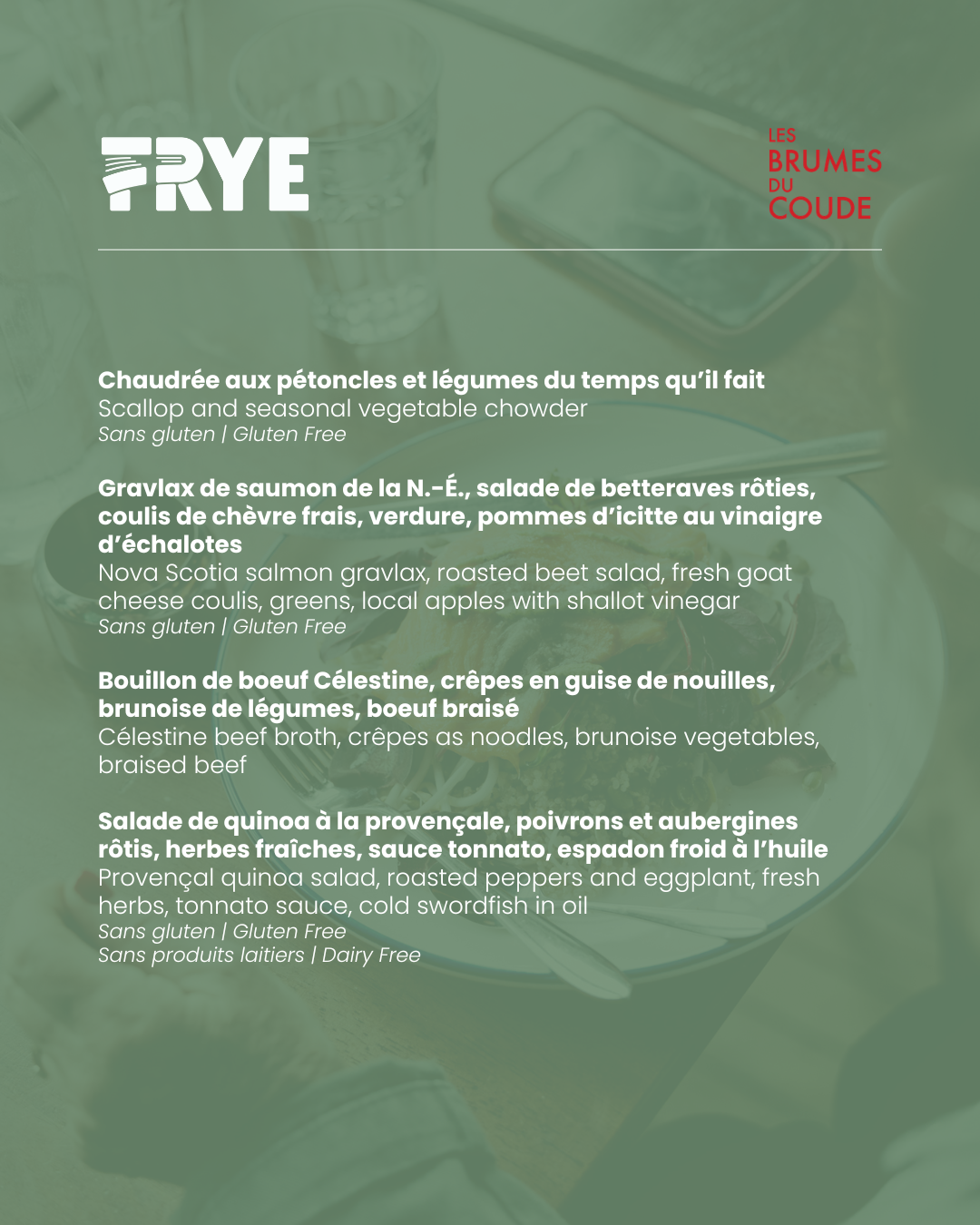
This novel begins when a scientist who has written a popular book of non-fiction attends a literary festival, where she strikes up a friendship with a charismatic novelist. The novelist reveals that her new work is an experiment: a novella she wrote in English only to have it translated and published solely in French—a language the novelist cannot read. Moreover, she has lost her original English manuscript of this work. Hearing this, the scientist, who is fluent in French, impulsively offers to retranslate the novella back into English for the novelist.

As she embarks on this task, the scientist finds herself haunted by vivid memories and distracting questions. These insert themselves into her translation process, troubling it, then disrupting it entirely. She desperately tries to complete her task before losing control of both the work and her well-organized existence.